
Tala Mua
Legends/Historical Tales
There are many kinds of stories (Tala).
Tala Mua are tales about the past in Nanumea and Tuvalu. In English they might be called Legends or Historical Tales — they are believed to be true accountings of events in the past History of Nanumea. These are our History — they are our past, as remembered by our elders today, and as such are extremely important.
In the recent past in Nanumea people would lie around on mats, pillows at the ready, the gentle light of a hurricane lamp or a “bottle lamp”, molii fangu, giving a cozy feel to this most homelike of activities. Younger children would often fall asleep as these tales were told by an elder.
These Tala never grew old — hearing them again and again is part of their charm. Different tellers add their own dramatic and vocal touches, adding depth and enjoyment.
We digitized these stories, which were originally recorded on cassette tapes. We are gradually posting new selections as we complete them -- check back from time to time to see what is new.
Heiloa Faga
Heiloa Faga (born 15 November 1893) was one of the oldest men on Nanumea in our time there in 1973-74. He was born the year after Great Britain “raised the flag” over the various Ellice Islands and proclaimed them a British Protectorate in 1892.
During the First World War when Heiloa was a young man he worked at the phosphate mining island of Banaba; he told us he had been the cook to Arthur Grimble, an important colonial officer, from 1914-1918.
His parents were Faga and Kaumua, both from Nanumea; Heiloa was raised as a tamapuke by Taukatea and Taupea (she was sister of Mataefa, mother of Kaumua).
Heiloa died in Nanumea about 1978 or 1979, at the age of about 86.
Tale of Kaimoko and Lupo — tape 33A (26 minutes)
About Foulua, voyaging canoes of the past (from story Kaimoko and Lupo) — tape 33A (about 3 minutes)
Tale of Poke, Taitai, Temotu - Warriors from Beru — tape 33A (21 minutes)
Kiti and Laina continue discussion with Heiloa about Nanumean history — tape 33A, 33B and ending on 30A (50 minutes)
Heiloa and Hangaa with Ane, 22 October 1973
Heiloa in Nanumea, 22 October 1973
Telangai Hipa
Telangai Hipa was born in Nanumea on August 14, 1924, the son of Male and Hipa. At the age of 25 he married Mamele (daughter of Vaepa and Takitua) and they had several children, including Megaa, Tiligana and Katagi.
These four historical tales told by Telangai were recorded for us at the home of Hipa and Male in Haumaefa iloto on December 5, 1974 by Telangai’s son, Megaa Telangai.
Telangai died in Nanumea on June 22, 1996. He was 71 years old.
Tale of the toa Kalihi and Teakaka — tape 6A
Tale of Teakaka and warriors from Beru — tape 6A
Tale of Taitai and Temotu — tape 6A
At Telangai and Mamele’s house, Matagi, 22 November 1973
Telangai, Mamele and Misianga in Matagi 22 November 1973
Iakopo Telaki
Iakopo was born in Nanumea in June, 1908, the son of Telaki and Seleta, both from Nanumea. Taliki’s parents were Teauli and his wife Tolu. Seleta’s parents were Pou and Kaveiga.
Jakopo had a working career away from Nanumea that lasted from 1928 to 1950, from when he was 20 until he was in his 40s: Sydney cutting copra, Banaba for about 9 years, and as a seaman for another 6 years.
He and his wife Koli had several sons, three of whom were away working when we met Iakopo in Nanumea in 1973.
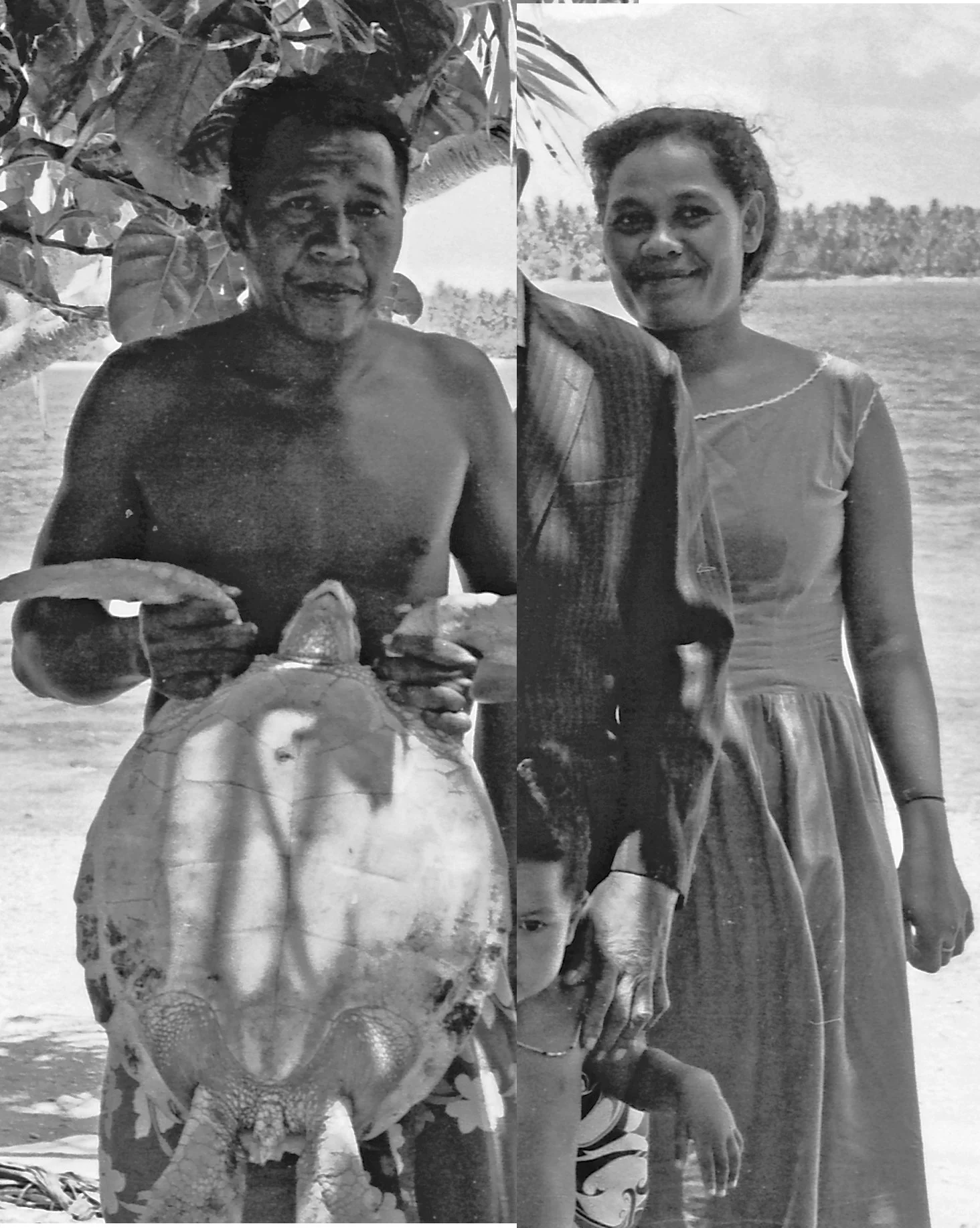
Tale of Mataliki and Melemele tape 19A (3 minutes)
Tuiao and the Women — Taro Pits in Lakena tape 19A(4 minutes 20 seconds)
Sitia Iakopo and his wife Matagaa Lipine Sitia
Iakopo with Sue and Matagaa — 13 November 1973
Tueve Tafalulu
Tueve Tafalulu was born in Nanumea November 29, 1900, the son of Tafalulu and Vava. Tafalulu’s parents were Matakea and Liki; Vava’s parents were Lata and Tukehe. Tueve was also known in his youth as Sikela.
Tueve worked overseas for many years: in Sydney making copra; on ships both power and sailing; in Banaba for some 15 years where for part of the time he was a Colony policeman; and for a period in Nauru. He was a fonopule member in Nanumea for a year in 1956.
In 1974 Tueve lived alone in the house next to that of Takitua and Susana in Lolua iloto and ate his meals with them.
Tueva told several stories, each of which explained some “failoga” or landmark in Nanumea. Keith and Laina Teuea talked with Tueve on May 30 1974 and made this recording.
Tueve died in Nanumea toward the end of July, 1980 - he was 79 years old.
Kaimoko and Lupo (and others)
Origin of the name Te Koko
Origin of Te Fatu a Kanapu
Tueve (Sikela) at home - 29 October 1973
Laina and Keith with Tueve - at his house, 30 May 1974. Some of this recording has poor sound quality, but it can be understood. Fakatoese mai! Tapes 12A and 12B (about 48 minutes)
Stories included in this recording:
Tepou Hoa
Tepou was born in Nanumea in 1909, the son of Hoa and Fongalei. Hoa’s parents were Tepou and Teaka, Fongalei’s parents were Tefolaha and Ingo. The house Tepou lived in in Nanumea (Lolua i namo) was originally Tefolaha’s house; he told us Tefolaha had been buried there.
Tepou was a leading and respected elder in Nanumea in the 1970s and 1980s. He still fished actively in his small Nanumea style canoe, and was a knowledgeable fisherman.
Recordings with Tepou include his demonstration of Fakanaunau Ika (see under Mulivaka), and 3 long interviews, which are on this page.
Conversation with Ane mo Kiti — 7 June 1974 (tapes 31A, 31B and 13A)
Conversation with Ane mo Kiti — 2 July 1974 (tapes 25A, 25B, 17B)
Conversation and stories with Ane mo Kiti - 31 December 1973 (tapes 18B, 25A)
Taulialia Poepoe
Taulialia was born in Nanumea on April 20, 1895, just a few years after Great Britain “raised the flag” and declared the Ellice Islands to be a Protectorate in 1892. His parents were Poepoe and Faiao, both from Nanumea. Poepoe’s parents were Temai and Tagaliki; Faiao’s parents were Telavi and Valahi.
Taulialia had an amazingly good memory and seemed to know the family trees of almost everyone in Nanumea. We were told, when we were going to each household and writing down their information, that some had sent a household member to ask Taulialia about their ancestors, so they would be prepared when we came to them. Some people joked that Taulialia was Nanumea’s “Encyclopedia”.
Taulialoa - te Vaega o te Papa mo te Lagi — lifting up of the Sky— tape 19A (2 minutes, ll seconds)
Fakafolau of Tekava; Folau of Piikia and Poepoe; Folau of Maake, Leni, Taeamo, Hamanu; About Laukite; About Molotea; Te Afaga of the Aitu
Taulialia telling six very short stories At Taulialia’s house December 16, 1974 about 9 p.m., recorded by Mengaa Telangai (tape 10B, length is 11 ½ minutes)
Taulialia’s 6 stories are:
Taulialia at his house — December 1974
Takitua Peni
Takitua Peni was born in Nanumea on September 16, 1903 (and died there 9 May 1984 aged 80). His parents were Peni and Lautolo, and grandparents Tongia and Ngaleoti on his father’s side, Mahi and Liua on his mother’s side.
Takitua had worked for the Colony of Gilbert and Ellice Islands as a younger man, and was a member of the council of chiefs in Nanumea in his later years, from the maga Tumau.
Takitua Peni and his wife Susana Laukava, 29 October 1973
Likilua (and Lapi and Vele) — tape 38A (10 minutes 48 seconds)
Tuulapoupou — tape 38A and 38B (10 minutes 12 seconds)
The Coming of Christianity to Nanumea — tape 38A (10 minutes 43 seconds)
Ceremony for the fakahopoga, seating of a new Aliki — tape 38A (5 minutes 33 seconds)
The first Football played in Nanumea — tape 38A (4 minutes 44 seconds)
Ane and Kiti discuss a wide variety of topics with Takitua, including the Aliki in Nanumea — tapes 30A, 11B and 6A (1 hour 35 minutes) — 24 August 1974
Takitua (striped shirt) and Susana, and others—29 October 1973
Venu Kelese
Venu Kelese was born in Funafuti on 17 December 1922. His parents were Kelese and Palae. Kelese’s parents were Taukatea and Taupea, Palae’s parents were Founuku and Mataapua.
As a young man, as the Pacific area was readying for war, Venu worked off the island for about 10 years. He spent time in Fiji as a stevedore in 1943, worked on Christmas Island making copra for two years, and then on Banaba working at the phosphate diggings for about seven years, before returning home in the mid 1960s. He was elected vice-president of the Island Council in about 1967, and in the mid 70s was a deacon in the LMS church on Nanumea. In between his work abroad he would return to Nanumea, and in 1952 he and Lotana Kaa were married in Nanumea.
During our 1973-74 stay in Nanumea Venu, served as president of the island council. In everyday life he was a modest and shy man. He had a good sense of humor and often used self deprecating humor in his speeches in the Ahiga. He particularly liked to joke about his English skills, which he admitted were low - he did not speak English!
He was also a very good storyteller, and we recorded some of his stories — you can hear them here.
Venu was a skilled fisherman, and we recorded some of his Muna o te Mulivaka — see Muna o te Mulivaka for those Logo.
Venu also recorded some of his Fishing Logo — they are here, or you can also see Muna o te Mulivaka and Fakanaunau Ika:
Fishing for Hahave, Palu, Atu(tape 35B and 3B, 1 hour and 16 minutes)
Traditional Division (Tufaga) of Fish Catch (tape 38B and 3A, 24 minutes 45 seconds)
Venu in the aahiga, October 1973. Child is Sauni.
Telea Mafoa
Telea Mafoa was born in Nanumea on June 28, 1913. His father was Mafoa Matakea, his mother was Tufekau. Mafoa’s parents were Matakea and Liki, Tufekau’s parents were Loo and Magiagi.
Story of Hinoki, Hina and Paakeva tape 6A (about 5 minutes)
Story of Matakea and the Great Oge iluga i Nanumea — tape 6A (4 ½ minutes)
Telea, his wife Fatusa, kids (front) Oliveta, (rear) Peletesi, Ieti and Atenga — 11 Sept 1974
Rongorongo Rusia
Rongorongo was born on August 24, 1924 in Beru in what was then The Gilbert Islands. His father was Rusia and his mother Sunema. Rusia’s father was Tukia, his mother Angoango. Sunema was from Samoa.
As a young man following the second world war, Rongorongo worked in Nauru for about 20 years. He had other work experiences on Banaba before the war, and also working as a seaman on ships. He spoke Tuvaluan of course, but also Nauruan and Gilbertese.
Rongorongo married Suiofu of Nanumea in 1973.
The Story of Fakaua’s name and the Tapu on it — tape 19A (9 minutes)
Rongorongo with his wife Suiofu - Nanumea 1984
In the ahiga, 25 March 1974